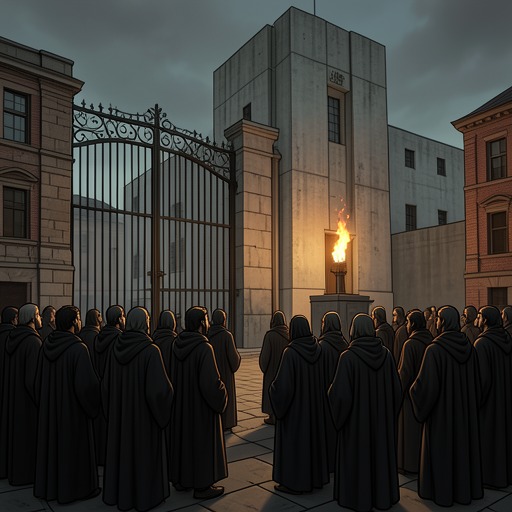
Royal Supremacy over the Church of England
The King's CurseRoyal Supremacy over the Church of England is Henry VIII’s assertion that the king, rather than the Pope, holds supreme authority over the English Church. In the novel, it is more than a change in church government: it becomes a demand that subjects accept the king’s account of his marriage, his family, and the succession as political and religious truth. Its force is revealed through resignations, oaths, and threats, as well as through the gap between royal command and personal conscience.
The king’s claim to govern the Church
At Westminster Palace, Lord Montague explains the change to Princess Mary Tudor: the Church has surrendered to the king, who will rule it himself, while the Pope is to be disregarded in England. The report describes a reversal in the hierarchy of authority. The king places himself beneath God but above the Church, and treats the Pope as no more than a bishop. Princess Mary Tudor immediately grasps the reach of the claim: in her understanding, the king has taken the Church, its wealth, its laws, and its courts into his own possession. Neither Lord Montague nor his mother can contradict her.
The narrative also marks this religious transfer through a change in royal style. After Henry VIII becomes the sole ruler of the Church in England, he claims the imperial title of Majesty rather than the older form of address used for a duke. The new title enlarges the distance between the king and his subjects, even as his own grief and physical vulnerability remain visible. Royal Supremacy thus appears both as an institutional claim and as an effort to make royal authority seem comprehensive and elevated.
Marriage, succession, and competing authorities
The dispute over the Church’s authority is bound to Henry VIII’s marriage to Katherine of Aragon. The king’s mother insists that Katherine’s claim that the marriage was never consummated is a lie, and fears that support for it will ruin her son and their house. She argues that the king could obtain a papal dispensation to marry his daughter-in-law if the marriage were declared invalid. Her demand that Margaret Pole affirm the marriage makes clear how a question of marriage status can become a test of loyalty to the dynasty.
The novel sets this royal position against a contrary ruling from the Pope. In 1534, when Thomas Cromwell administers the Oath of Succession to the peers at Westminster Palace, the Pope has publicly ruled that the marriage of Henry VIII and Katherine of Aragon is valid and that Henry should live with his wife. The Pope has not excommunicated the king, however, and the narrator distinguishes knowing that the king is wrong from having authority to defy him. The oath therefore confronts its subjects with competing jurisdictions: papal judgment, royal command, and individual conscience.
The succession oath makes the conflict practical. It asks the nobility to accept the king’s account of which marriage is valid and who may inherit. In the narrator’s understanding, Henry VIII’s declaration has transformed Katherine into a woman who is no longer his wife, Anne Boleyn into his queen, and Anne’s child into a princess. The king’s power to declare these things true is presented as a power to define public reality. The disputed status of the marriage is not separate from Royal Supremacy; it is one of the claims through which that supremacy is asserted.
Oaths and the price of conscience
The oath administered by Thomas Cromwell places the conflict before the realm’s peers as a formal test. Margaret Pole remembers Thomas More’s refusal: he was willing to sign a rewritten version but could not sign the oath as it stood. More did not condemn the men who drafted or signed it; he treated his refusal as a matter of his own soul. Henry VIII had promised that he would not put his friend to this test, but the promise is broken. More’s resignation as Lord Chancellor and departure from office make the conflict between royal demand and personal conscience visible in public life.
The oath’s reach also extends beyond noblemen. When Henry VIII will not bring Princess Mary Tudor to court unless she takes the oath, the king sends Norfolk to confront her, and the pressure is described as a threat of arrest and execution. Eustace Chapuys tells Lord Montague that Princess Mary Tudor must swear that her parents’ marriage was invalid and that Henry is head of the Church, in order to buy time for a possible escape. The episode presents assent not as uncomplicated agreement, but as something demanded under the shadow of punishment.
Held at Hunsdon, Princess Mary Tudor is given a document called The Lady Mary’s Submission and told that refusal will bring a treason charge carrying a death sentence. Six men are already held in the Tower of London on suspicion of trying to rescue her, and their lives depend on her decision. She signs three clauses: she accepts Henry VIII as king and promises obedience to his laws; recognizes him as supreme head on earth of the English Church; and acknowledges her parents’ marriage as unlawful under divine and human law. The sequence shows how one declaration of ecclesiastical supremacy is joined to obedience, dynastic legitimacy, and the danger of treason.
Resistance and the limits of the claim
Royal Supremacy does not silence every challenge to the king’s authority. Thomas More’s refusal, and the imprisonment of More and John Fisher, demonstrate the cost of maintaining a contrary judgment. Margaret Pole’s account of her own silence around Henry VIII and her reluctance to speak against him likewise places the burden of conscience inside personal relationships. Under pressure, speech and silence both acquire political consequences.
The conflict continues through Reginald Pole’s writing. When Henry VIII discusses Pro ecclesiasticae unitatis defensione, he asks whether he is Defender of the Faith and Supreme Head of the Church of England, then treats his son’s challenge to his right to govern the Church as an insult and treason. The scene turns a disagreement about ecclesiastical authority into a charge against the challenger. The king’s claim is therefore shown not only through official oaths but through his insistence that questioning the claim itself can constitute disloyalty.
The rule’s significance lies in this conversion of spiritual jurisdiction into a test of political obedience. Henry VIII’s supremacy reaches into marriage and inheritance, shapes the terms on which subjects may appear at court, and places dissenters at risk. Yet the narrative keeps the competing claims in view: the Pope’s ruling, More’s conscience, Princess Mary Tudor’s understanding of her parents’ marriage, and the coercive power of the crown. Royal Supremacy is presented as a bid to make the king the final authority over both the Church and the meaning of lawful allegiance, not as a consensus that resolves the conflict.